Derek is Managing Director of the UK Mediation Service Group, a nationwide provider supporting families through separation, child arrangements, and financial matters.
A trained mediator with over 9 years’ experience in the mediation field, Derek founded UKMS on the belief that mediation should be simple, affordable, and accessible to everyone, and that with the right support, people can reach fair, constructive outcomes without the stress and cost of going to court.
When a relationship ends, court is the route most people think of. Mediation is the other option, but with plenty of misconceptions around it, people don’t always have a clear picture of how it works.
It’s worth noting that “going to court” doesn’t always mean standing in front of a judge on day one. Most people who take that route instruct a solicitor, and the two sides negotiate through letters, often for months, before a hearing is listed. Plenty of cases settle along the way. But the costs build up whether or not you reach a final hearing, and the pace is set by solicitors’ correspondence and the court’s diary rather than by you.
So here’s how the two routes compare across the three most pressing questions clients ask: what it costs, how long it takes, and what it’s like to go through.
Short answer: mediation at UKMS costs £1,299 per person for the full process, takes three to six weeks for a straightforward case, and leaves the decisions with you. A contested court route typically costs £10,000 to £30,000 per person in solicitor fees and takes 35 weeks on average.
How much does mediation cost compared to court?
Court itself is not the expensive part. The fees for applying to a family court are set by the government and they’re fairly modest. What pushes the bill into the tens of thousands is solicitor fees, which build up with every letter, phone call and hearing.
Here’s what a separation costs via the courts at the time of writing:
Court fees (these apply whichever route you take)
Divorce application (if you’re married): £612
Court fee to lodge a consent order: £60
Court fees if you apply for a court to decide
Child arrangements application (C100): £263
Financial order application (Form A): £313
Solicitor fees if your case is contested
Typically £10,000 to £30,000 per person, and sometimes more
Even a relatively straightforward case rarely comes in under £5,000
Here’s what mediation costs with UKMS (per person)
We don’t charge for completing court forms such as the C100 or Form A. And if your case involves children, the government’s Family Mediation Voucher Scheme puts £500 towards the cost. It isn’t means-tested, so it applies whatever your income.
Court (contested)
Mediation (UKMS)
Typical cost per person
£10,000 to £30,000+ in solicitor fees, plus court fees
£1,299 for the full Agreed package, less the £500 voucher where children are involved
Court forms
Typically charged by your solicitor
Included
How long does mediation take compared to court?
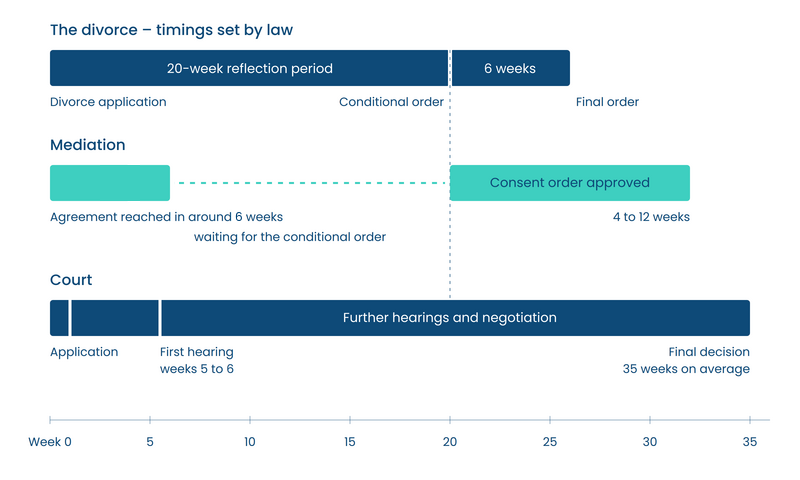
The family courts are busy. In the first three months of 2026, the average case involving children took 35 weeks from application to conclusion, and only around half finished within 26 weeks. The first hearing alone is usually five to six weeks after you apply.
In contrast, mediation moves at your pace. We can usually arrange a MIAM within 24 hours. Most people need two to five mediation sessions: on average, three or four for finances and two for children. And a straightforward case usually reaches agreement in three to six weeks.
One thing that stays consistent whatever route you choose is the divorce timeline itself. The legal process in England and Wales takes a minimum of 26 weeks, regardless of which route you take. Mediation runs alongside it, so by the time your divorce comes through, your finances and child arrangements are already agreed.
Court (contested)
Mediation (UKMS)
First appointment
Five to six weeks after applying
Often within 24 hours
Typical time to resolve
35 weeks on average, longer for complex cases
Three to sixweeks for a straightforward case
Who sets the pace
The court’s listing schedule
You and your ex-partner
Is mediation less stressful than court?
In court, a judge makes the decisions about your children and your money. In mediation, you make them. That’s why agreements reached in mediation tend to hold: both of you shaped them, so you’re more likely to stick to them.
Court proceedings are formal and often adversarial: each side presents its case and a judge decides the outcome. Mediation deals with the same serious issues, but in a calmer setting. An accredited mediator guides the conversation. They don’t take sides or give advice, but they do keep things relevant, productive and moving forward. One person speaks at a time, and both of you get a response. Sessions typically take place online, and where needed the mediator can move between separate calls.
This matters especially where children are involved. A court process can harden positions on both sides, making it harder to co-parent when it’s over. Mediation keeps the focus on practical arrangements, so you finish with something workable for all of you. Where it’s appropriate, we also offer child-inclusive mediation, which gives your children a chance to share their views with the mediator in a separate, informal conversation, so their needs and preferences are taken into account – without them being put in the middle.
What you say in mediation is also confidential and legally privileged. You can put forward proposals and explore options without worrying they’ll be used against you later. The one exception is your financial disclosure. The documents you share, such as bank statements, pension valuations and mortgage details, are a record of the facts at the time. That means either of you can refer to them if your case later goes to court. What you say about those figures, and any offers you make, stays protected.
Court (contested)
Mediation (UKMS)
Who decides
A judge
You
Format
Formal hearings, each side presenting its case
Structured conversation, guided by a neutral mediator
Privacy
Court record
Confidential and legally privileged
Where court still has a role
Mediation needs both people to take part. If your ex-partner won’t engage, if one of you isn’t willing to disclose your finances, or if there are safety concerns, mediation might not be the right route. You’ll still need a MIAM first in most cases, and your mediator will talk you through whether mediation could work for you. If mediation isn’t suitable, your mediator signs the form so you can apply without delay, and our Direct to Court package supports you through the application.
What this means for you
For most separating couples, mediation gets you to an agreement in a few weeks, at a fixed cost, with decisions you’ve made yourselves. Around 80% of UKMS clients avoid court altogether.
The simplest first step is a MIAM. We can usually arrange one within 24 hours, and in most cases you’ll need one whichever route you take. Or if you’d rather talk things through first, we offer a free 15-minute consultation. You can also see how our Agreed service resolves everything in one place.
Continue reading
You may also be interested in this related content from our mediation experts
Home / Insights / Family mediation vs court: cost, time and stress compared
We track how people interact with our online web content and resources, and some of that tracking involves storing cookies on your device. By continuing to use our site you accept that you agree to this. For more details see our Privacy Statement.

 310
310