https://ukmediationservice.org.uk/insights/consent-order-after-mediation/
The UK Mediation Service Group Limited, We make family mediation simple 1200627
Mediation Insights
Mediation and consent orders: making your agreement legally binding
The UK Mediation Service Group Limited, We make family mediation simple310310
Derek is Managing Director of the UK Mediation Service Group, a nationwide provider supporting families through separation, child arrangements, and financial matters.
A trained mediator with over 9 years’ experience in the mediation field, Derek founded UKMS on the belief that mediation should be simple, affordable, and accessible to everyone, and that with the right support, people can reach fair, constructive outcomes without the stress and cost of going to court.
One of the questions we’re asked most often is whether an agreement reached in mediation is legally binding. It can be – that’s where a consent order comes in.
Once you’ve been through mediation and reached an agreement, your mediator documents it in a Memorandum of Understanding, a written record of what you and your ex-partner have decided, and how you arrived at it. Where finances are involved, it sits alongside an Open Financial Statement setting out the full picture you both disclosed. For most people the next step is to have that agreement drawn up as a consent order and approved by a court, so that what you’ve agreed can be enforced and neither party can reopen matters later.
This article covers what that step involves, what it means, and why it’s worth considering.
Why people choose to formalise their agreement
Divorce doesn’t automatically bring financial claims to an end. The final order dissolves the marriage, but it doesn’t resolve what happens to your property, savings or pensions.
In England and Wales, the financial claims that arise from a marriage stay open indefinitely until a court dismisses them. The clearest illustration is the case of Wyatt v Vince. A couple married in 1981, separated in the mid-1980s and divorced in 1992, at a point when neither of them had significant assets. No financial order was made. Years later, the husband founded a green energy company that became worth many millions. In 2011, 19 years after the divorce, his former wife brought a financial claim against him. It reached the Supreme Court, which confirmed that there is no time limit on claims of this kind, and the case eventually settled.
Although not necessarily to that extent, most people’s circumstances do change: an inheritance, a business that takes off, a property that doubles in value, a pension that matures, a redundancy. The point is that neither of you can see twenty years ahead, and an informal agreement offers no protection as things change.
What closes that door is a clause within a consent order dismissing each party’s claims against the other. This is referred to as a clean break. It’s worth knowing that a clean break isn’t a separate document; it’s a provision within the consent order. It can take effect immediately, or be deferred to a future date where maintenance is being paid for a fixed period first.
Finances and child arrangements are treated differently
People often assume that if they’ve agreed everything in mediation, it all gets wrapped up into a single order. In practice, finances and arrangements for children are treated differently by the courts.
Where finances are involved, most people go on to submit a consent order. Part of that is closing off future claims, but there are also practical steps that depend on having one. Pensions are the clearest example, and often the largest asset a couple holds after the family home. A pension provider will only act on a sealed order from the court, not on a private agreement between the two of you.
Arrangements for children tend to go the other way. The Children Act 1989 sets out what’s known as the no order principle: a court won’t make an order about a child unless doing so would be better for that child than making no order at all. In practice, many parents who reach a workable agreement in mediation don’t go on to a court order at all – and that’s the expected outcome. What most parents leave mediation with instead is a child arrangements agreement, which is a clear written record of the arrangements that both parents can revisit as things change. Arrangements that suit a four-year-old rarely suit a fourteen-year-old, and changing a court order means reapplying to court, so that flexibility is something parents often find useful.
There are situations where turning a child arrangements agreement into an order is the right step, and your mediator will talk through whether your situation is one of them.
Another thing worth knowing is that where child maintenance is included in a financial consent order, it’s only binding for twelve months, after which either parent can ask the Child Maintenance Service to assess it.
What’s involved in getting a consent order
Applying for a consent order is an administrative step. Your agreement is drawn up as a draft order in the form the court requires. That’s submitted alongside a statement of information (Form D81), which summarises both parties’ finances and is signed by you both, and an application form. A judge then reads the papers. In the vast majority of cases, neither party needs to attend court. The judge’s role is to check that what you’ve agreed is fair and that you both understood what you were agreeing to. Once satisfied, the court seals the order and it becomes enforceable, with the same standing as any other court order.
Where a consent order fits in the divorce timeline
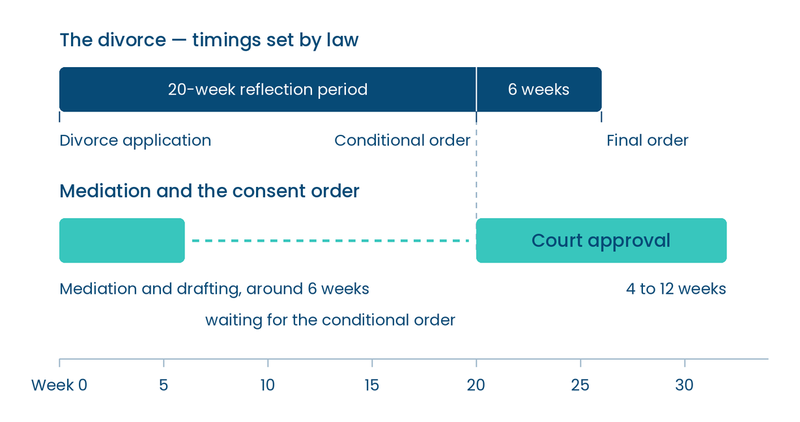
The consent order can’t be submitted until the divorce itself has reached the conditional order stage (previously called the decree nisi), so mediation and the divorce process usually run alongside each other.
Apply for the divorce. By law there’s a minimum 20-week wait between the application and the conditional order.
Mediation and your agreement. Mediation runs alongside that waiting period. Most of our clients reach a full agreement within three to four weeks, and your mediator documents it in a Memorandum of Understanding.
Drafting the consent order. This is done while you wait, so it’s ready to submit as soon as the court can consider it.
The conditional order. Once the conditional order is granted, the draft consent order can be submitted, along with a statement of information about both parties’ finances and the court fee (which at the time of writing is £62).
Court approval. A judge reviews the papers. This typically takes four to twelve weeks depending on the court’s workload, or longer if the judge comes back with questions.
Sealing and the final order. Once approved, the order is sealed and becomes a court order in its own right. Most of its terms take effect when the final order of divorce is made.
Resolve everything in one place
UKMS can support you through the whole process via our Agreed service: from your first MIAM (Mediation Information and Assessment Meeting) to a sealed consent order. Your mediator drafts the Memorandum of Understanding and Open Financial Statement, and the consent order is drawn up and submitted through our legal partner so you’re only dealing with one team, start to finish.
Whether you’re at the start of the process or holding a Memorandum you’re not sure what to do with, the quickest way to understand where you stand is to talk it through with someone. We offer a free 15-minute consultation to answer your questions and help you understand the process and your options.
Continue reading
You may also be interested in this related content from our mediation experts
Home / Insights / Mediation and consent orders: making your agreement legally binding
We track how people interact with our online web content and resources, and some of that tracking involves storing cookies on your device. By continuing to use our site you accept that you agree to this. For more details see our Privacy Statement.

 310
310
310
310